In a city still negotiating its relationship with memory, How to Build a Library turns the act of rebuilding into something quietly defiant. It’s not just about salvaging a building ,it’s about reclaiming space, authorship, and the right to remember. There’s a peculiar kind of tenderness in films about rebuilding: they are, by design, optimistic and impatient at once. How to Build a Library,Is a film by Maia Lekow and Christopher King. It is an eight-year chronicle of two Kenyan women attempting to restore Nairobi’s McMillan Memorial Library. The film sits squarely in that emotional territory but it does more than document renovation. It asks why public memory matters, who gets to steward it, and how the ghosts of colonial architecture continue to shape our civic imaginations.
The film follows Shiro (Wanjiru Koinange) and Angela Wachuka as they attempt a project that is equal parts practical and symbolic. To revive a city landmark that, until independence, functioned largely for a white audience and has since fallen into neglect. The directors filmed the project over nearly a decade, and the patiently accumulated footage gives the film both a procedural backbone. The grant applications, the fundraising galas, the bureaucratic dead ends, and the tenderness of human persistence. The film premiered at Sundance in January, 2025 and has since been screened at festivals including True/False Film Festival, Munich’s DOK.fest, CPH DOX , Sydney Film Festival, ElGouna Film Festival among many others signaling its international reach. It was also the opening film at Encounters Doc Film Festival in South Africa earlier on in the year and the NBO Film Festival in Kenya on the 16th of October 2025.
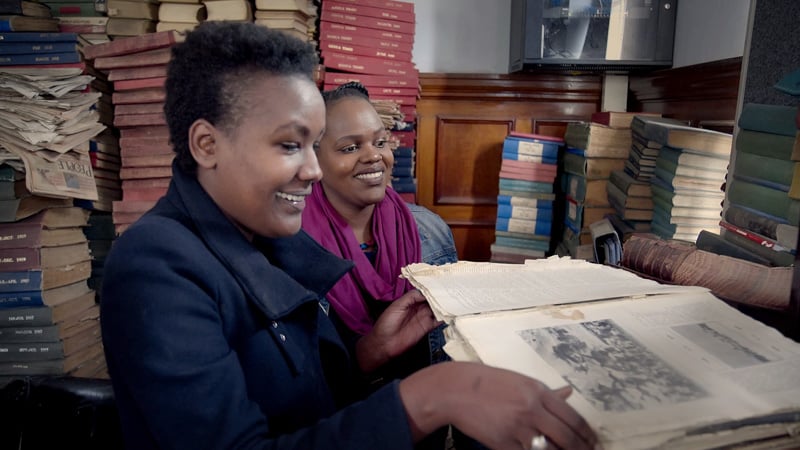
Visually, How to Build a Library alternates between intimate, handheld moments and wide, architectural frames that let McMillan’s bones speak for themselves. The cinematography is careful. It lingers on cracked cornices, sunlit reading rooms, and stacks of uncatalogued books the way a conservator would examine artifacts. That attention to the material reality of the building is the film’s strength.It refuses easy metaphor and keeps returning to the tactile ;dust, paper, and the communal act of reading. The creative team’s long-term access produces rare images , not just of restoration work, but of the small negotiations and tensions that happen when a public institution is reimagined. Not just from the people it could benefit, but to a different class of people who see this as a way to get something from it.
The film is also fairly and usefully a study of process. Much of its dramatic thrust comes from bureaucratic inertia: changing political winds, funding hinges on tenuous mandates, and internal friction with existing staff who sometimes view the newcomers’ methods with suspicion. This is where Maia and Chris’ approach is both admirable and, a little bit frustrating. By choosing a mostly observational mode, they make the slow grind feel real. You see the meetings that lead nowhere and the small victories that barely register in press statements. But that patience can also flatten narrative momentum.
Where the film truly comes alive is in its insistence on decolonization as both symbolic act and practical labor. Restoring McMillan is not merely about repainting walls. It’s about interrogating collections, curating whose histories sit on public shelves, and imagining access for a new generation. The film captures the friction of those conversations. What to keep, what to remove, how to reorganize a library whose taxonomy was designed by the colonizer. These debates, lucidly rendered, give the documentary intellectual weight: the project becomes an entry point into conversations about public memory, literacy, and cultural reclamation.
Performance in this documentary is not the actors’ work but the moral clarity of its protagonists. Shiro and Angela are compelling not because they are flawless but because their commitment is heartfelt and strategic. You watch them navigate media, donors, and local politics with a mix of idealism and savvy that feels brutally necessary; they are not magicians but organizers, and the film honors that. The directors amplify their agency without turning the duo into mythic saviors; in quiet moments, the personal stakes ,what this building means to the city, and to their own histories, come into focus. Still, the film leaves you wanting to know them beyond their mission, to see who they are when they are not rebuilding the library. They exist on screen almost entirely through the lens of their work, with only small, scattered moments hinting at their personal lives. It’s effective in maintaining focus but leaves a faint ache for intimacy, for a glimpse into the women behind the vision.
If the film has a limit, it’s in the question of scale. The very specificity that makes McMillan a powerful case study also raises a larger question the film only gestures toward: how replicable is this model across the continent?
As documentary cinema, How to Build a Library succeeds in giving us a front-row seat to the work of civic restoration. It is lucid without being didactic, measured without losing heart. For Kenyan audiences, and for anyone interested in questions of cultural inheritance, the film is an invitation: to look closely at the spaces we inherit, to ask who they serve, and to imagine what it takes to transform them into places of belonging. Also to imagine which places have pieces of our history and still remain untouched, unknown.
How to Build a Library is a patient, necessary film about cultural stewardship. It may feel procedural at times, but its insistence on detail and its humane portrait of two determined women make it quietly powerful. Watch it for the tactile beauty of archival space, for the stubborn will of civic guardianship, and for the stubborn reminder that rebuilding a library is, always, a political act. And yeah, toilets are very lucrative as a business in Kenya.




Leave a comment