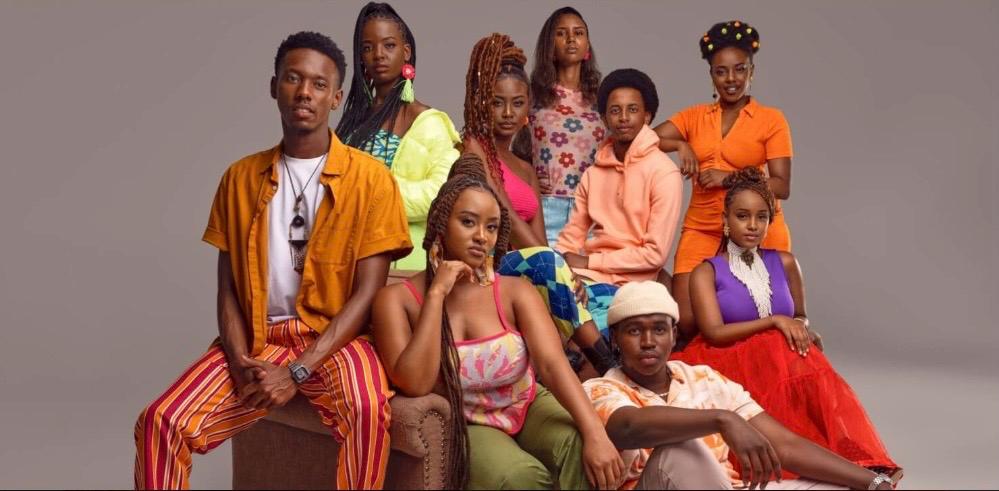
And then we came to the finale. Eight episodes of Shuga Masharaki Season 1 done, a revival of Kenya’s most acclaimed youth TV series, brought to us again by MTV’s Stayig Alive Foundation.
But first, let’s go back to late 2009 when the OG Shuga dropped. I was in my coming-of-age life phase when those three episodes aired. You had to have been there, my friends. When those luminous titles appeared accompanied by that breathy percussion track, when Juliani dropped that spoken word piece about Nairobi, when Lupita rushed down bustling Nairobi streets after a dalliance with a sugar daddy, when those frenetic cast intros played on screen… we had never seen anything like it. Not with people who looked like us, spoke like us, and inhabited the same spaces we did.
The show careened from Nairobi streets to homes to classrooms to clubs and back to the streets as the soundtrack pulsated with the Kenyan pop music of the day. Cameos peppered the series, Nameless would show up in a club, Bon-eye of P-Unit would drop rhymes at a car wash, while Jimmi Gait (remember him?) led a praise and worship session in a campus CU session. It was all so gorgeous and so well-packaged that we were all “inside that storo mad”. Three years later, ‘Nairobi Half Life’ dropped, and you know the rest. An industry was truly born.
Enough has been said about that golden age already. This article, though, is about the series reboot, which brings together a cast of fresh-faced, neon-lit Kenyan talent, including Serah Wanjiru, Basil Mungai, Matthew Ngugi, Fridah Mumbe, Makena Kahuha, Julie Brenda, Fatuma Gichuru, Mariam Bishar and Wilson Muchemi, with appearances by Jackie Matubia, Brian Kabugi, Arabron Osanya, Kirumburu Ng’ang’a and Esther Kazungu.
The cast weaves in and out of the series, chic and colourful, their new world augmented by digital technology, 21st Century lingo and generous shades of colour. When I settled down for Episode 1, I was ready to rekindle the love I felt in 2009. As Makena Kahuha leaned out of a taxi, just like Sharon Olago did sixteen years ago, and shouted those iconic words, I was ready to be inside again.
I dove into Ep.01, waded into Ep.02, plodded into Ep.03, and tip-toed cautiously into Ep.04, and eventually made it to the closing credits of the finale, and all I can say is… What?
There isn’t a single original moment, not one character fleshed out enough to come off as human. Every single one; from the several leads, to the diverse cast of supporting characters, is a trope. The actors play so faithfully to type, that you can predict their actions moments into a scene. Pay enough attention and you could recite their dialogue with them. I can’t tell you of any moment where I felt a pop of dramatic tension. There wasn’t a story beat we didn’t see coming. Well, there was that one moment when the rugby team appeared during a campus demonstration. And the bit where the Christian Union leader inexplicably *checks notes* cheated on her HIV-positive boyfriend with a pilot she met at a bar?
Shuga exists in a universe of youth-focused TV shows that address social issues. Like Paa, Njeri and Tuki, it’s been made for specific demographics, showing them ways to navigate life in more informed, empowered ways. It is therefore obligated to be, at the very least, representative and relatable; depicting believable people and scenarios that entertain and educate.
Shuga Mashariki, at its best, tries. But the attempts at combining story and advocacy cancel each other out. I wasn’t sure what I was supposed to take out at the end, because it went from stitching lessons into scenes, to leading disjointed story threads towards a bewildering season finale.
Despite work from a visibly large team, Shuga doesn’t feel directed. It doesn’t even feel structurally written. You could be convinced that a cast and crew showed up, cameras rolled, then a lottery was held to see what cuts would end up in the final edit.
When the obligatory social messages are included, nuance is forsaken for blunt-force berating, with dialogue copy-pasted from clinic brochures, Twitter threads and TikTok monologues. Moments take themselves so seriously, they play out as soap opera spectacle, and no character is spared. Even the background actors move like NPC’s in a video game that needed multiple reviews before it went to market.
Events play out like isolated vignettes, pushed along hastily so we can get to the next moment, and the next and the next. We don’t get to sit with anyone long enough to know what’s really going on with them. Every scene, every line, every choice is derivative of something you’ve seen before. It may all have landed better if it was delivered with a self-aware levity; but the melodrama, the awkward turns of phrase, the theatrical facial expressions, make for magenta-tinged, overloaded clutter.
It all looks gorgeous, though. Opulent photography meets ornate production design, with the good-looking cast placed in every frame. But all of this means very little for a show whose material feels like slog.
I genuinely felt for the actors, many of them defined by much stronger work. Here they were, confined to “Jock”, “Angry Radio Girl”, “Snarky Podcaster”, “Only Fans Vixen” and “Clueless Virtuous Christian” (and my God that last trope needs to die already. How about checking in with real-life faithful, because nuance exists in their lives too).
And now let’s talk about the plot twist upon which the whole series depends. It’s signaled so early on, that you can almost hear wah-wah horns play when the ploy is revealed.
This is where you stop reading if you don’t want spoilers.
Are you still here? Last warning.
Okay, so now…
What the hell was that ending?
How do you peg 8 whole episodes on that? What was the series trying to say all along?
Did the makers think about what they were subtly perpetuating? Why did they give the season’s most detestable, most abominable, most violent character the most nuance, empathy and screen time? Why did they make us like him? Feel sorry for him? Were they trying to create a “clever” smokescreen for the finale? Why, even after the reveal of his heinous crimes, did the murderer receive the literal star treatment? Season 2 had better atone thoroughly for this!
Did the writers imagine themselves as non-conformist artists for breaking the most basic storytelling rules? Is there no one in the approval process that saw the combination of ill-advised thematic ideas that fed into that finale?
Here’s the problem; Shuga Mashariki took grim, complex social themes, and then played touch-and-go with them. It dove into rough waters only to splash around in the shallow end. It fetishised real-life horror. Because why film a gruesome murder in gorgeous nightlight, letting the images linger on screen longer than they ought to, then let the killer ride off triumphantly into the darkness, (accompanied by a naive potential victim no less)? Why open a gashing wound and walk away without presenting a remedy, thought, or a tribute? All the while leaving the other key messages unresolved?
This has to be the first time I’ve seen a public service message inadvertently aggravate the very issue it’s meant to confront.
The show has its virtues, but they do little to shift the mishandling of its larger, more urgent themes. Take for instance, the bombast of a rugby team strutting down a campus street in minimal women’s clothing. It’s meant to be a turning point in the boys’ contemptible views on women, and sets the ground for a rousing speech condemning femicide. This is followed by a fracas that echoes present-day maandamano, and little more is said of that afterwards. Nothing more is made of the riot, or the speech, or the fall out. And that there, is the misguided virtue in action. The show just carries on. Why even go there when the wounds of the very real youth protests are so fresh? Where’s the sensitivity? The storytelling wisdom? The duty of care?
Why were the two murder victims depicted as visibly (and neglectfully) inebriated? Why did it feel like they were paying for their sins? Even when the murderer, fresh off disposing of a body, meets his third potential victim (as far as we know), he leers at her as she stares back with not a hint of suspicion. Her only crime (and damnation) is a distinct and clichéd upcountry naïveté. Why, my goodness why?
Season 1, all nostalgia aside, was ingenious and genuine. But close to two decades later, we exist in the vortex of clickbait. We make “content” that burns hot and fast, and wanes quickly, in time for the next big thing. Every commissioned piece, every “adaptation” appearing on our screens can’t seem to outlast its hype window.
Shuga is only a microcosm of a whole industry. We don’t lack the skill, talent, lived experience or goodwill to make truly groundbreaking work. But all of it is subdued by insidious things – gatekeepers, myopic interests, ego, profit and know-it-alls who know little. We see their fruits. Audiences have caught on. This is a come-to-Jesus moment, and industry players ought to sprint to the altar like a Rachel Girl on CU day. Otherwise, they will play second fiddle to the up-and-comers unafraid of big thoughts on low budgets.
For better or worse, it is these people who are giving us the real sugar.
Written by Zinja N.



Leave a comment