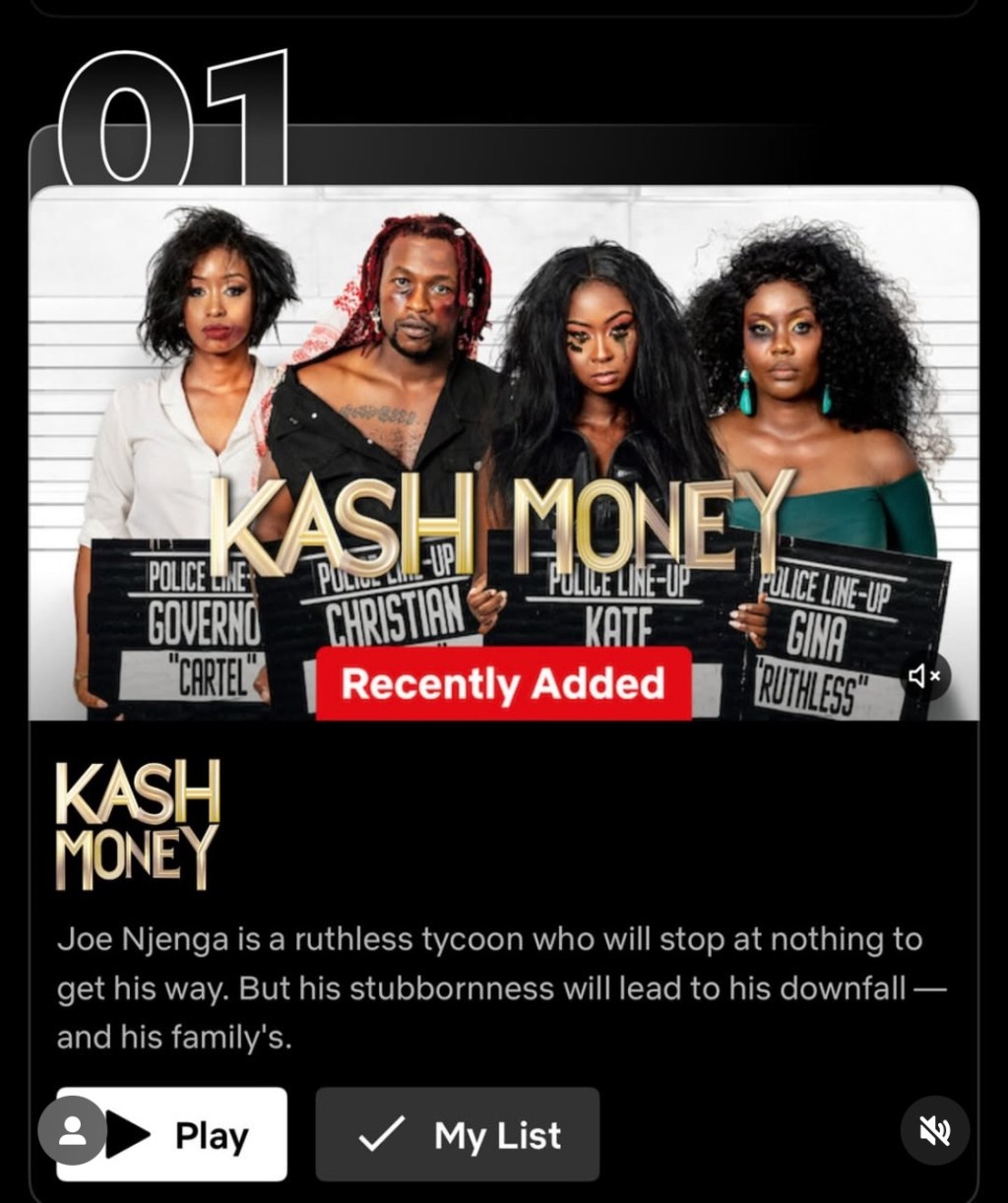
Another series on Netflix! There’s something deeply satisfying about seeing another Kenyan series land on Netflix, especially one that isn’t restricted to just our borders. Kash Money is not only available in Kenya but also in Nigeria and South Africa—an exciting and possibly groundbreaking move. For years, most Kenyan productions on Netflix have been geo-locked, limiting their reach and preventing wider audiences from experiencing our stories. But with Kash Money, we might be witnessing a shift—one that could open the door for more Kenyan content to gain the global recognition it deserves by being available to more than viewers in the 254. The series got trending at number 1 in Kenya, number 3 in Nigeria and number 7 in South Africa during its first week on the platform.
Kash Money is by Insignia productions under the craftsmanship of Philippe Bresson and Grace Kahaki, the duo behind Single Kiasi an entertaining TV show on Showmax. The series stars Sanaipei Tande playing Georgina aka the trophy wife, Industry veteran John Sibi Okumu who is the Patriarch of the wealthy Njenga family, singer Amara Tari playing Kate, Janet Mbugua playing the governor, Morris Mwangi who plays Christian, Dedan Juma who plays Sossa, Ronnie Kariuki who plays Shady aka the governors son, Lenana Kariba who plays Njagi aka the cousin, Maqbul Mohamed who plays detective, Oliver Litondo whose voice guides us into every episode, Joey Muthengi, Shiv Singh among others. Now that is a star studded cast!
So, does Kash Money live up to this big moment? Let’s break it down.
Kash Money is a drama that weaves an intricate web of secrets, betrayal, and dark family dynamics, all revolving around the mysterious death of the wealthy and powerful Joe Njenga. On the very first episode, the series does an excellent job of building suspense, drawing the audience in with every new character introduction. The series has familiar themes and occasionally leans on familiar tropes—power struggles, betrayal, big secrets, blackmail…effective but not entirely fresh. As the series progresses, a lot is promised, a lot of suspense is built only to get to a narrated resolution which is a very unsatisfactory payoff.
Let’s start with the performances. Sanaipei’s portrayal of Georgina is a standout performance. She expertly captures the duality of her character, balancing Georgina’s conniving nature with moments of unexpected affection. Tande allows us to feel the tension between Georgina’s love for money and her relationship with her ben 10 boyfriend, adding a few layers of complexity to her performance. While her character could benefit from more development, Tande does a commendable job of drawing us into her world, making Georgina a fascinating yet imperfect figure. I still don’t get why they made her shout a lot though.
With John Sibi playing Njenga, his performance starts strong, as he effortlessly commands respect with both his presence and verbal delivery. However, his character feels somewhat one-dimensional, lacking depth and development. Despite his evident talent, there’s a rigidity to his portrayal, as if there’s more to his character that we never get to see. While his authoritative tone is consistent, the absence of nuanced action leaves his role feeling underwhelming, especially for an actor of his caliber. His interaction with the lady who is supposed to be the chief of staff is given some sort of relevance only for it not to be explored. Something I feel would have been great to build on Joe’s character. Sossa, played by Dedan Juma, is a captivating presence—his look, speech, and mannerisms all align perfectly with the character. He’s both intimidating and hilarious, delivering a standout performance. While he lacks depth, it hardly matters—his sheer entertainment value carries him through.
Now when it comes to Kate, Amara Tari’s portrayal of Kate falls flat, struggling to draw the audience into the story. Instead of immersing us in her character, her performance in most scenes feels more like a recitation of lines with hints of emotion sprinkled here and there. She only seems to come alive in moments of conflict or meanness, which doesn’t fully capture the complexity of Kate. In one scene, after discovering that her boyfriend is also her cousin, Tari’s reaction feels emotionally disconnected. While her voice conveys distress, her facial expressions fail to match the gravity of the moment. Whether due to a weak script or her delivery, her performance doesn’t quite hit the mark. However, this possibly being her first screen role, some grace is due.
Morris Mwangi plays Chris, and his introduction feels straight out of a Texas movie scene, which, in the context of the story, seems a bit irrelevant. However, his relationship with his daughter unveils a sweeter, more caring side of him, and their chemistry is undeniably strong. While this adds a layer of warmth to the character, Chris could have benefited from further depth. Some of his actions in key scenes seem out of place, confusing the audience, as they contradict what we’ve come to expect from him. Mwangi’s performance balances between great talent and underdeveloped character, leaving us wanting more complexity from his role.
The detective, played by Maqbul, is introduced with a strong sense of authority and competence, immediately establishing his expertise. However, his inconsistent language switching across different environments creates a sense of dissonance, making it difficult to fully grasp his character’s identity. Lenana Kariba’s character, Njagi, also suffers from weak development, existing primarily as Kate’s boyfriend and a vehicle for the cousin relationship twist. While he initially appears to have significance—perhaps as a potential investor or a key figure in Kate’s proposal—this setup is quickly undermined. The abrupt shift to their relationship dynamic in the ‘dungeon’ scene renders his earlier introduction almost meaningless, leaving the audience questioning the necessity of that initial presentation. It’s only in the final episode that Njagi finds some semblance of purpose, but by then, his character arc feels more like an afterthought than a carefully woven thread in the narrative.
The governor and her son, unfortunately, suffer from the weakest development in the film. Janet Mbugua’s portrayal of the governor holds untapped potential—she is the only character with true power over Patriarch Joe Njenga, yet she is reduced to a mere plot device, appearing solely to reinforce the arranged marriage storyline before vanishing from the narrative entirely. Her son, Shady played by Ronnie Kariuki, is frustratingly one-dimensional. It’s difficult to tell whether his annoying nature is a testament to the actor’s effectiveness in playing the role or simply a result of poor characterization. Like his mother, he is introduced, serves a singular purpose, and then disappears without resolution. This lack of development is a glaring missed opportunity—both characters could have added significant depth and stakes to the story had they been fully realized.
The story starts with great potential, drawing viewers in with an intriguing premise and a strong buildup. Several narrative threads are introduced, each adding layers of complexity, and the use of tropes and gimmicks helps keep the momentum going. However, the resolution, which hinges on a flashback from 51 years ago, ultimately falls flat. The filmmakers fail to tie up the many threads they’ve so carefully woven throughout the film, leaving key plot points unresolved. To point out one, what was that proposal that Kate raved about in the first episode only for it never to be mentioned again? This lack of closure feels like a promise unfulfilled, frustrating the audience and raising more questions than answers. As a result, the film loses credibility, and despite its strong premise, the storytelling feels incoherent and incomplete.
The series’s use of VFX is a promising step forward, showcasing a growing embrace of technology in African cinema. The incorporation of AI-generated shots is particularly commendable, signaling a willingness to experiment with new tools. While the execution wasn’t flawless, it’s a step in the right direction, and I give grace for the effort. The editing also starts off strong, with clever gimmicks that enhance the storytelling, but their overuse eventually dulls their impact, making them feel more like distractions than creative flourishes.
The series looks fantastic—polished, high-quality, and visually appealing to the average viewer. However, experienced filmmakers and colorists might feel the characters’ faces look too smooth, almost artificial, instead of having natural texture. It seems to aim for an A24-style look, and while some may say it comes close, others might argue it completely misses the mark. In the end, it’s up to each viewer to decide which side they’re on. The overuse of establishment shots, drone footage, and stock clips ultimately cheapens the film. The repeated shots of Karen House before every scene set there feel like an insult to the audience’s intelligence. While the intention might be to signal that we’re entering Njenga’s house, doing so before every scene becomes absurd. It’s distracting, pulling us away from the story rather than enhancing it, leaving us questioning whether there’s even a cohesive narrative to follow.
This series dares you not to watch it with your conservative parents as it uses curse words frequently, with the F-word being dropped in nearly every episode. While this isn’t necessarily a problem, the issue lies in who is saying it and whether it truly adds to the story. Does it reflect our society realistically? It’s one thing for a character to use the word, but it feels forced when every character is dropping it. It doesn’t serve the narrative and risks feeling out of place, as not everyone in real life would use such language in every situation.
Kash Money offers an exciting step forward for Kenyan content on Netflix, breaking geographic boundaries and trending across multiple African countries. The series has an intriguing premise and benefits from a star-studded cast, particularly Sanaipei Tande and Dedan Juma, whose performances stand out. However, the narrative falls short in its execution.
The series screams potential, but also significant flaws which I think could be avoided with proper pre-production. It is great to see another series on Netflix from Kenya. It is disheartening to see another incoherent narrative.
The series scores a 5 out of 10.


Leave a comment