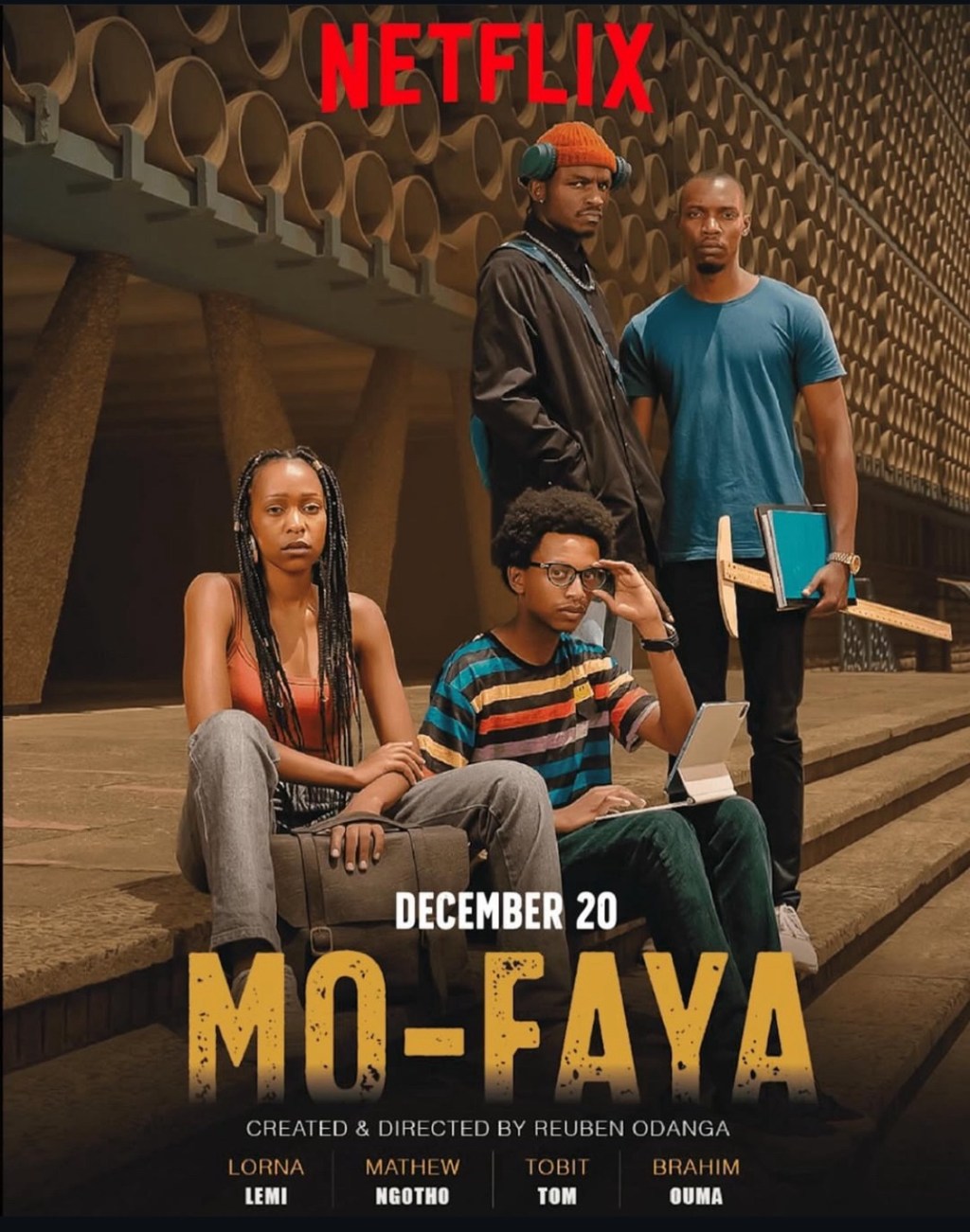
Kenya’s presence on Netflix has been steadily growing, with an increasing number of local films and series making their way onto the global streaming giant. This is an exciting time for Kenyan storytellers, as the platform offers a chance to showcase our diverse narratives to audiences worldwide. However, as more Kenyan productions join Netflix’s catalog, one can’t help but wonder: what are the quality control measures in place for these films and series? While the visibility is a win for the industry, it raises questions about whether every production meets the standard expected of Netflix Originals or licensed titles. Mofaya, the latest addition to the lineup, provides a perfect case study for this conversation.
Mofaya is a series that follows Zawadie played by Lorna Lemi, who after her mum’s passing and her not so good relationship with her father Wafula played by Melvin Alusa, decides to immediately go back to Nairobi with Brian Matata played by Brahim Ouma, who is the student leader at her university. She quickly discovers that Brian is involved with some shady stuff but after a bit of reluctance, she aids him in getting away from the police. This is how she, a Christian Union active member ends up as part of the inferno gang.
In this series, we have a few familiar faces and more new faces which I must say is a win especially because the audience has been complaining about seeing the same faces on screen every time! Part of the cast not mentioned above are Tobit Tom, Melvin Alusa, Cate Rira, Blessing Lung’aho, Alice Ngina among others. I absolutely loved the use of other languages other than Swahili and English! We are making progress guys!
Mofaya presents a compelling premise that is both intriguing and layered with emotional depth. It is a crime drama to be more direct. The story starts off really well building anticipation. However, as the story progresses, the weaknesses of the story become more and more evident. The foundation is great, but the loopholes that come almost immediately after are quite disappointing and they keep going.
Let’s start with what works though. Zawadie played by Lorna Lemi goes through quite a transformation. From a grieving daughter who is part of the christian union team to the girlfriend and partner in crime of a criminal, to the girl rallying up fellow students to free their criminal student leader. This change in Zawadie is great, however, I felt like I missed some scenes because I didn’t’ exactly figure out her why. Why did she choose to join the gang? Was it out for love for her new boyfriend or out of defiance to her father? The reason is there, but isn’t clear. Lorna’s character is really well played despite the script’s shortcomings. Her scenes with Melvin , playing Wafula her dad feel very authentic and easily pull us in. Speaking of Melvin Alusa, his character is well fleshed out. We understand him, his conflicts, his background and his motivation. What becomes what I would call a loophole, is how did he become the new OCS? Did I miss something in the series? His promotion felt like it came out of nowhere. His relationship with Cate Rira ( can’t remember her character’s name) was also well written. Their chemistry on screen left us guessing whether it was just platonic and/ or she wanted it to be more. Her relevance in the story was a bit undercooked. I wish they showed us the kind of relationship Zawadie and her had. Again, another part I felt like I missed a scene.
Now Brahim Ouma who plays Brian Matata … His role wasn’t well fleshed out. We did know a few things about him. Who he is, his family, his friends and maybe two girls he liked. However, who is he working for, who are these people he keeps talking about? What are the consequences of not complying. We certainly know his why. The guy is just trying to ensure his mom has a good place to live in and that he provides for his child. Also, what exactly is the beef with his dad? In terms of performance, his character was truly disappointing. His language felt very disconnected. I think I caught a bit of a western accent. As much as the script let him down, he also let himself down. Tobit Tom on the other hand was a well written character, and he hands down ate his role. He was very grounded and owned “Onyi ” fully, so that scene at the end where he gets shot, was the script writer betraying him because that’s not how he was presented at first. So yet again just like in volume, we have the supporting role shining brighter than the lead. Involuntarily.
Alice Ngina really did justice to her role. She was conniving, convincing and sly. Alex Mwakideu also did deliver a good performance but his character was also not well fleshed out. There were inconsistencies in who and what his character was and wanted. Blessing Lung’aho did great for the few minutes he was on screen. I however, must point out how sloppy his character was. How did he find things out? What makes a good cop is their ability to investigate, connect the dots, and uncover the truth. Unfortunately, Mofaya misses the mark in this regard. The series rarely delves into not just Blessing’s character but most of the cops investigative skills, leaving us with cops who react rather than lead. This lack of depth undermines the realism and tension expected in a story that incorporates law enforcement. Before I forget, what was the reason that rich kid was stealing? And he got more excited than the rest after finding out how much money was in the vault. And the others had to remind us at the crime scene why they were stealing.
I will pose the loopholes that I haven’t addressed yet as questions. Were the robberies the inferno gang doing connected? Why those specific robberies? What was the purpose of the miss university event? I mean apart from pushing the drugs. The girl who was dating Brian and later had a fling with the nerd kid, what exactly was her relationship with Brian? What was that girl who later went with the ambassador doing in the casino? Her character was of absolutely no use to the story! Why would the gang rob the ambassador in the middle of town? I know suspension of belief exists in film for a reason but it is important to keep the viewer immersed in the story. There are certain questions you do not want your viewer asking because it pulls them away from the story. The bank robbery scene was poorly acted and at this point I can’t blame the script, the director is responsible for this scene. Also did Zawadie pay her boda rides? Zawadie rallying up students to go fight for their student leader who was a criminal leaves me with a lot of moral questions and sadly fails to tap into my emotions.
The script feels rushed, resulting in numerous loopholes that leave the story undercooked and incomplete. This lack of depth affects the show’s bingeability, making it easy to remember that you’re watching a work of fiction rather than being fully immersed in the story. It fails to draw you in or make the narrative truly compelling. The series is riddled with small mistakes, from incoherent editing effects that feel completely out of place for the tone of the film. Outrageous errors, like a huge bulb of lighting visibly showing in the frame, pull the viewer out of the experience and highlight the lack of attention to detail. Combined with subpar cinematography, which could have otherwise anchored the series visually, these flaws weaken the overall production quality and make it hard to take the story seriously. Mofaya is entertaining, but given the experience of the production team that did this, they could have done way better.
While it’s undeniably a win to have Kenyan content featured on Netflix, these issues—rushed scripting, misplaced editing effects, visible mistakes like lighting equipment, and subpar cinematography—raise serious questions about the platform’s quality control. Kenyan viewers have long shown immense support for South African productions on Netflix, which consistently meet a high standard. It’s only fair that Kenyan audiences are given equally exceptional films from their own country, ensuring that Kenyan stories can compete on the same level and showcase the true potential of our local talent.
The series scores a 4.5 out of 10




Leave a comment